
Sizing an AFFF foam trolley starts with hazard class and target discharge time, not catalogue browsing. The most common error we see is over-specifying capacity and under-specifying discharge nozzle.
The discharge nozzle matters more than the tank
A 45 L trolley with a properly sized induction nozzle outperforms a 200 L trolley with a mismatched nozzle on small fuel spills. The trolley is a delivery vehicle — the discharge math is what matters.
A starting point for class B hazards
For class B fuel-loading bays of 50 m² or smaller, a 100 L trolley with an inline inductor at 3% concentration is the workable starting point.
For aviation hangars and tank-farm spills, a 200 L trolley is the floor, not the ceiling.
What we ship
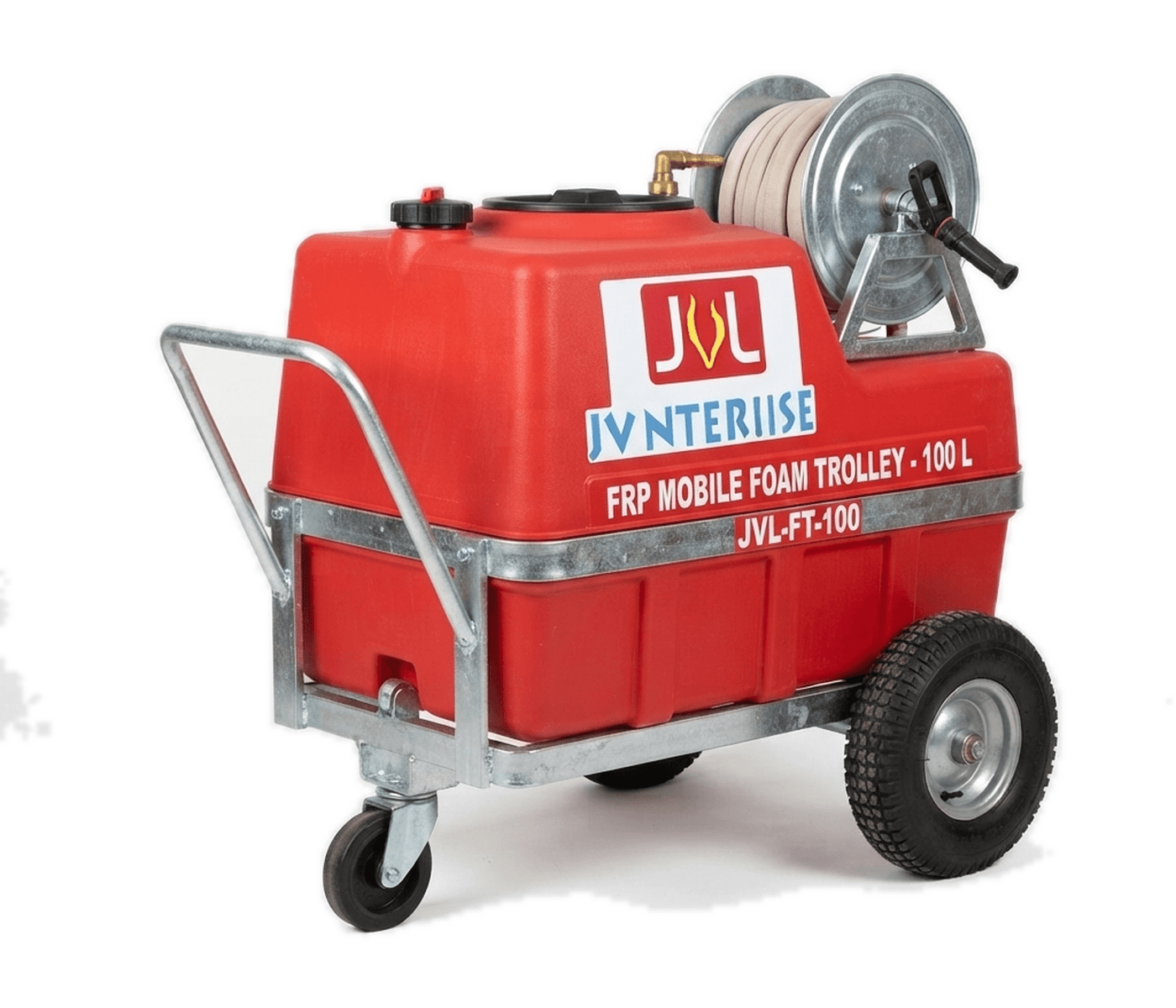
The JVL 100, 150, and 200 L foam trolleys share the same hardware kit — 5 mm FRP body, inline inductor, FB-5X foam branch, RRL Type-1 hose with SS coupling, MS wheel stand with SS handle. The choice is capacity-driven.
When to call us
If you have a bay layout drawing and a hazard classification, send both via the inquiry form. We'll come back with a trolley capacity, inductor size, and discharge duration — turned around in one business day.